Feeds:
Posts
Comments

Posts Tagged ‘Happy Little Sigh’

If you’re alive in America today, you’re probably acquainted with the Lindsay Clancy trial. Lindsay admitted to brutally murdering her three young children one by one, beginning with the oldest, though the defense argued that the murders were a result of Lindsay having post-partum psychosis. I’m not here to debate whether or not she should be held criminally responsible. You can interact with keyboard detectives in plenty of other places if you’re interested in that. My concern goes far beyond this particular case (though this particular case is a concern—three young children lost their lives). What also troubles me is the response so many women have had to the crime–their primary sympathy lies not with the true victims, but with the one who committed the murders. Women across the Internet and outside the courthouse proclaiming, “I stand with Lindsay,” and “Me too, Lindsay.” Women filming themselves flicking water at their babies’ faces and using a doll to mimic dropping their children down the stairs. Women on Oprah saying that they hope if minority women do the same thing, that they will receive equal support (the mother, not the children). Women suggesting that murdering your children is understandable if your hormones really are pretty bad. We seem to have forgotten that we can have sympathy or compassion while still demanding justice. God help us.

What have women in the West become? On the one hand, for those concerned about women’s rights, I wonder that they don’t realize how this kind of behavior undoes hundreds of years of struggle—regressing us to the days when women were lobotomized and thrown into insane asylums for “female hysteria.” Now we’re going back to, “I couldn’t help harming my child—my hormones made me do it”? How can we be taken seriously if we’re going to use that argument? And how can we then go on to argue against a man blaming his testosterone for all sorts of heinous acts? We can’t. Not rationally.

On the other hand, this is a natural progression in our society’s loss of belief in the sacredness of life. This is most apparent in our abortion culture, where the limit for killing a child for “the welfare of the mother” edged ever closer to full-term, which is where we are today. We even debate about whether an abortion survivor should be kept alive. In Canada, a mother who murders her baby of up to one year “when childbirth or lactation has “disturbed her mind” faces a maximum sentence of only five years in prison. The next logical step is to minimize the worth of the lives of toddlers and children.

The “Wine Mommy Culture” is an offshoot of this disdain for children, where mothers joke about needing wine just to get through a day with their kids—as if motherhood is something we need to numb our minds against in order to survive. I’m not talking about joking about diaper explosions or stepping on LEGO—a little mom-humor goes a long way in relieving stress! I’m talking about the Wine Mommy Culture where women think it’s funny to joke about what grasping little brats their children are—how they’ve inconvenienced them and keep them from the life they deserve.

Many married couples are choosing not to have children at all. Not from infertility, not because of some other worthy calling, but because they want to spend their lives having fun. They are choosing instead to become dog-parents. You can, after all, shut up your dog in a kennel if you don’t want to deal with them, and can legally give them away if they stop meeting your needs and bringing you joy. That makes sense. ALL of this makes sense with the extreme love of self that has taken hold of society. I’m glad that some of those people have chosen not to have children. Their selfishness wouldn’t make them good parents. But it’s sad for our society. Sad because children are the greatest of blessings we can receive on earth, apart from a good spouse and knowing Christ. Motherhood and the family were once celebrated and revered, and research shows us that women were happier in those days! God’s word says,

“For people will love only themselves and their money. They will be boastful and proud, scoffing at God, disobedient to their parents, and ungrateful. They will consider nothing sacred. -2 Timothy 3:2

I’m not saying motherhood isn’t hard. It is. I’ve birthed four, adopted one with special needs, and next month I’m bringing home three more. Not because it was easy it’s been so easy for me. I have sat hunched over a newborn at 2AM, crying as I feed them from cracked, bleeding nipples. I’ve been so tired I could do nothing but collapse in a heap and weep. I have anxiously Googled remedies and fretted over hundreds of concerns for my children. I have lain awake waiting for a teenager to come home. I have held a screaming, thrashing teenage girl who’s trying to make sense of her world. No, I never had a diagnosis of postpartum psychosis, but I have known my share of mama-hard. Why so many children then, when it’s hard? Because they have been my and my husband’s greatest joy, and raising and loving them has been our greatest honor. Because being selfish doesn’t make us happy in the end, but living for and submitting ourselves to something greater brings more joy than I can express.

“Children are a gift from the LORD; they are a reward from him.” -Psalm 127:3

Women can do hard things, physically and mentally. Men may shed their blood in war. But it’s the women who during those same battles find a corner in the din to nourish their babies with their own bodies. I can’t help but think of women through the ages, who in the most extreme of circumstances, gave their all—even their own lives—for their children. Women of the early church, who nursed their babies even as they ran from the murderous emperor Nero, who was determined to snuff out the Christians. The women of medieval times, who gave their last crumb so their children could survive the upheaval of war. Women on the Mayflower, who cared for their children on leaky ship for months, putting their unknown future into God’s hands. The pioneer women, who hunted, foraged, fought for the sakes of their children. The women of the Holocaust, who did everything imaginable to keep their children alive. If anyone had an excuse for having a victim mentality and throwing their children aside to save themselves, it would have been these women. But instead, their sacrificial love put their children first, and for that they are honored, talked about, and imitated to this day.

So many great men and women owe their greatness to the love, care, wisdom, and sacrifice of their mothers. People like St. Augustine, Abraham Lincoln, D.L. Moody, Susanna Wesley, Constantine, and Louisa May Alcott all attribute who they became to their mothers. These were brave mothers. Unselfish mothers. Mothers who didn’t make excuses or think of their own happiness above their children’s. How might these people have turned out if their mothers had seen their children as an annoyance or a burden, instead of taking on the great heartfelt endeavor of raising them well? The world would have been deprived of some of the best.

This is my call to us all, we women of the Westespecially those of us who claim Christ. We need to stand against this devaluing of the lives of the helpless, whether they are children, the disabled, or the elderly. Let’s stop the victim mentality, stop excusing our bad behavior, and step up. We need to hold ourselves and each other to a higher standard—not in judgment of each other. Not in looking down our noses at each other. But by inspiring each other and pointing each other toward greatness—toward Christlikeness. By helping one another to better love our husbands and children, as the Bible tells us to do. By encouraging each other to stop living for our own flesh and start living for the Lord.

I’m not saying, if you’re suffering then just ignore your own needs, buck up, and go on without getting help. Approximately 0.1-0.2% of women do receive the diagnosis of post-partum psychosis, with symptoms usually appearing 1-2 weeks after delivery. If you or someone you know falls into that category, and you do find yourself considering violence toward yourself or your child, then please–do not turn away help, and put your children in a safe location until you are 100% sure that you can care for them safely. If you are suffering with mental illness, or chronic illness, or are in a dangerous place, take time each day to work on healing and putting yourself in a better place. That is not selfish—you do matter! And being healthy enables us to do so much more for God and our families.

I am so thankful that the Scriptures acknowledges real suffering and injustice. The Bible tells us, “Cast all your cares upon [God], because he cares for you.” (1 Peter 5:7). Our deepest healing mentally and emotionally is done in conjunction with a closer walk with God, who brings joy to our hearts and puts even the deepest suffering into eternal perspective. But also, the Bible tells us that in this world, we WILL have trouble (John 16:33), and even in our weakness and sickness, we can still bless our families and bring glory to God. This brings to mind another great woman, Joni Eareckson Tada, who has spent her entire adult life paralyzed from the neck down. Yet with her art, music, books, speaking–and most of all with her patience, wisdom, and joy in the Lord, she has been a blessing to many. Being in a hard spot is not an excuse for sin. The Bible consistently calls individuals to personal accountability rather than permanent helplessness. It’s hard to hold on to a permanent victim mentality, which so often is used as an excuse for bad or selfish behavior, when we are filled with a spirit of thankfulness and joy that comes from closeness and obedience to Christ.

“But the fruit of the Spirit is love, joy, peace, patience, kindness, goodness, faithfulness, gentleness and self-control.” – Galatians 5:22

Contrast this to someone who is not living according to God’s ways, but is living for themselves . . .

“When you follow the desires of your sinful nature, the results are very clear: sexual immorality, impurity, lustful pleasures, idolatry, sorcery, hostility, quarreling, jealousy, outbursts of anger, selfish ambition, dissension, division, envy, drunkenness, wild parties, and other sins like these. Let me tell you again, as I have before, that anyone living that sort of life will not inherit the Kingdom of God.” – Galatians 5:19-21

We might say, what about the people who have wronged me? Aren’t they partly responsible? Yes, health care workers, and teachers, and husbands, and friends and family members–actually, in any role we have–we all have a responsibility to care for others the best that we can. But no one can stand before God for the choices we make—even in the direst circumstances—but ourselves.

I’m not calling for perfection—that’s not possible. God knows each of our stories, all of our hurts and histories, and He will meet us and strengthen, heal, and equip each of us in a personal way. Progress will look different for each of us. But that does not mean we can’t make progress, moving ever closer to the likeness of our God.

Let us not be women who guide their lives by their own comfort, pleasure, and fulfillment. Who are addicted to wine, addicted to pleasure, materialistic, and trapped in a victim-mentality.  

Instead, let us strive to be the St. Monicas, the Nancy Lincolns, the Betsy Moodys, the Helenas, and the other women who are remembered today for their prayers and faithfulness, even in the hardest of times. To be women who are focused on bringing glory to God. On loving our children and husbands well. On caring for our homes well. On standing for truth and righteousness. On moving ever closer to a likeness of our Savior. Women of integrity. Humility. Joy. Strength. Peace. Perseverance. Love. It may seem impossible, but we women are strong—and in Christ, who is our strength in weakness, we can do all things! (2 Corinthians 12:10). Let us live so that when our children are grown, or when we come to the end of our lives, it is said of us,

“Many daughters have done noble things, but you surpass them all!” -Proverbs 31:29

Avonlea xo

Like this article? Want more inspiration? Find me at . . .

Facebook Happy Little Sigh

Instagram @happy.little.sigh

Bookish Devotionals for Busy Moms FREE here

Read Full Post »

“She watches over the affairs of her household and does not eat the bread of idleness.” 

– Proverbs 31:27 BSB

In the early days of our marriage, John and I watched The Untouchables, the Prohibition-era thriller about crime boss Al Capone (Robert De Niro) and Prohibition agent Eliot Ness (Kevin Costner). The only thing I remember about the film is that I hated the violence–and one scene where Ness calls home to his wife. After getting off the telephone, he says to the other men in the room, “Some part of the world still cares what color the kitchen is.” I identified with that line, and never forgot it.

I got a lot of pushback from some fellow moms over my encouragement for people (especially mothers) to stop reading the Epstein Files. One commented that I was the kind of person who would simply sit and pray and hope Goliath would stop killing the Philistines. In a way, she was right. And this goes for my role and perspective toward all of the evils of this world. I am mama bear, the Keeper of My Home, and I will learn about the evils that are coming at my family–from dangers online, to the corrupt food industry, to the dangers of trafficking. I will learn just enough about these evils to know how to best keep my family safe–and no more. I will learn just enough, and I will pray.

Not because I don’t want these evils stopped–I do. But I will not be the one on the front lines tackling criminals to the ground, tracking down traffickers in the night, or fighting court battles. Some women do, and I am grateful for the females who are there to help other women and children in these vulnerable situations. Social workers, doctors, nurses, and others who step in to provide much needed care. But that is not my personal calling. I am a wife and homeschooling mother. For me to pour over the perverse, violent details of these crimes would do nothing to advance the cause of justice. What it would do is waste my precious time, numb my mind to evil, and fill my thoughts with grotesque images, where it should filled with beauty–beauty that I want to bestow on the lives of my children.

“I want you to be wise about what is good and innocent about what is evil.” -Romans 16:19

Having our home and family as our first priority does not mean we stop caring about the anyone outside our family, or stop supporting the cause of justice and the defense of the helpless. God tells us to do this, and we can, through contacting our Representatives, donating to organizations that work to end injustice, signing petitions, participating in peaceful marches, volunteering at women’s shelters or pregnancy centers, fostering, adopting, or being a temporary safe home for children, and by showing hospitality. These are far more useful ways of impacting our communities and world for good than going down endless rabbit holes reading of the evils of this world.

“She opens her arms to the poor and reaches out her hands to the needy.” -Proverbs 31:20 BSB

The other accusation against women who don’t want to read all of the Epstein Files, or be fully informed about every evil going on in the world, is that we’re being like an ostrich with our heads in the sand, pretending none of the evil is happening. I hope you can see that’s not true. I am NOT pretending evil does not exist in this world. It is because of the evils of this world that I take my job as homemaker so very seriously. It is because of the evils of this world that I want to guard my mind and heart. It is because of the evils of this world that I understand the importance of my home being a haven for my family.

It’s okay to care about the of color the kitchen walls. It’s okay to want to make a tasty dinner. It’s okay to spend time finding the best books for your children. The reason Eliot Ness was out there fighting evil was so that his wife and children, and other women and children, could be safe at home–the home that his wife was turning into a delightful place to be. Why do the police, soldiers, doctors and others do what they do, but so that we can be safe at home? Why do many of our husbands go out to face the world every day, but so that we don’t have to, and so that we can be keepers of our homes, able to raise our children with purpose? They protect those at home. And it is our jobs as wives, mothers, and homemakers to make home what it is. After all, if no one is there caring about anything–from the color of the walls, to the books on the shelves, to what is going to be on the dinner table tonight–then what is there worth coming home to? And if you’re not going to do it, who will? I can’t overemphasis the importance of the job. There is no shame in our trying to create a place that is cozy, welcoming, inspiring, nourishing, attractive, and clean. To our families, and society as a whole, the haven of home is almost everything.

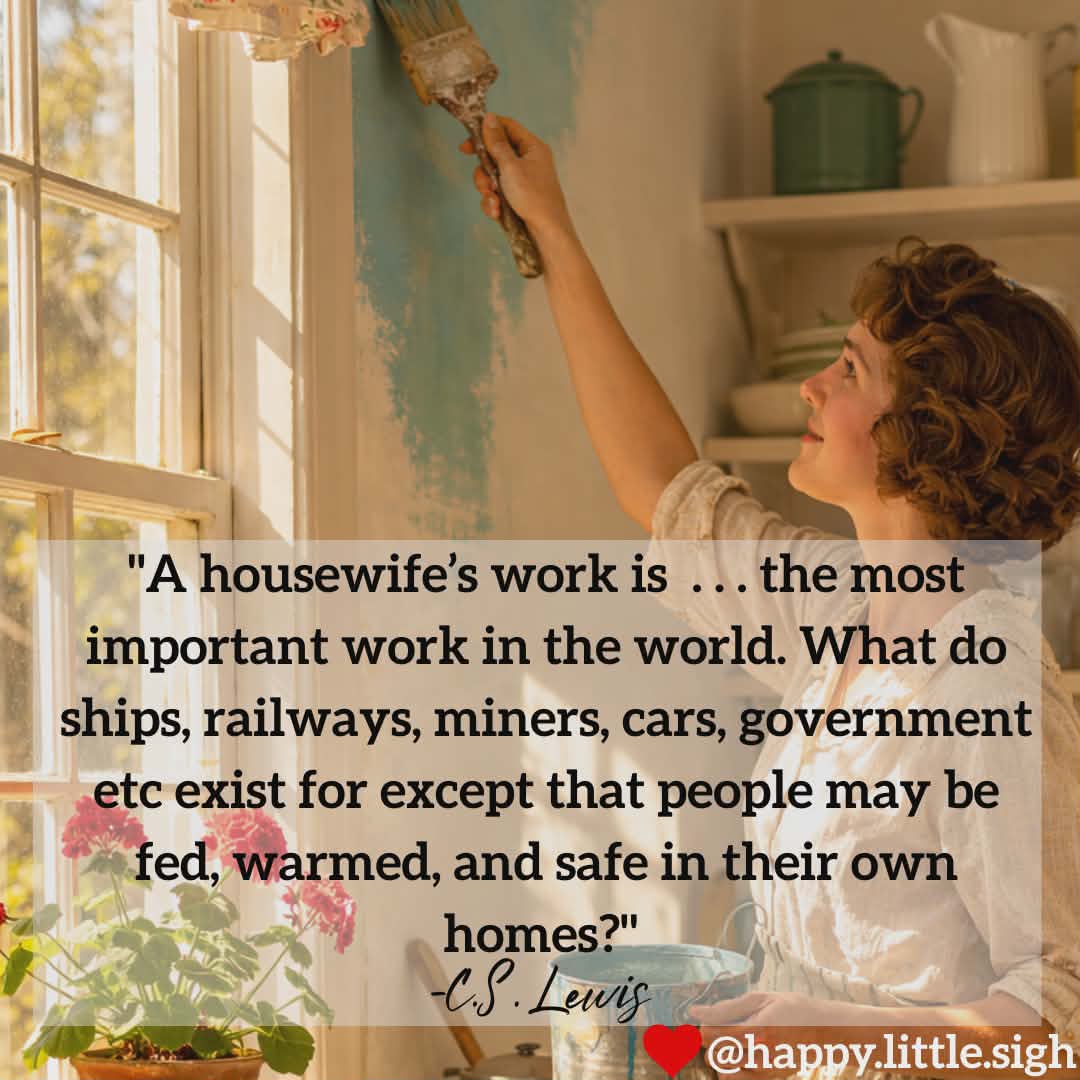
“A housewife’s work . . . is surely in reality the most important work in the world. What do ships, railways, miners, cars, government etc. exist for except that people may be fed, warmed, and safe in their own homes?”-C. S. Lewis

“To be happy at home is the end of all human endeavor.”-Dr. Johnson

Yes, we can get so wrapped up in creating the perfect décor and appearance of beauty that we neglect building inward, true beauty in our lives and the lives of our families. For what is home primarily, but the garden where we grow and nurture the children God has put into our care, with the most important lesson being to know Him. Filling our minds and time with fluff is a problem, too. We need to be on guard on every side. If our present calling is to be wives, mothers, or homemakers, then we should do that job with all of our heart–and that might just involve caring about the color of the kitchen walls.

Learn to love mornings & grow in faith . . .

Bookish devotionals for busy moms. Sign up here FREE

Connect with me on Instagram/Facebook @happy.little.sigh

Read Full Post »

The release of the Epstein files has forced many of us to consider—what do we do in the face of evil? When do we make it our business, and when do we look away? When do we gather every explicit detail, and when do we leave that job for someone else?  When do we share what we know, and when do we stay quiet?

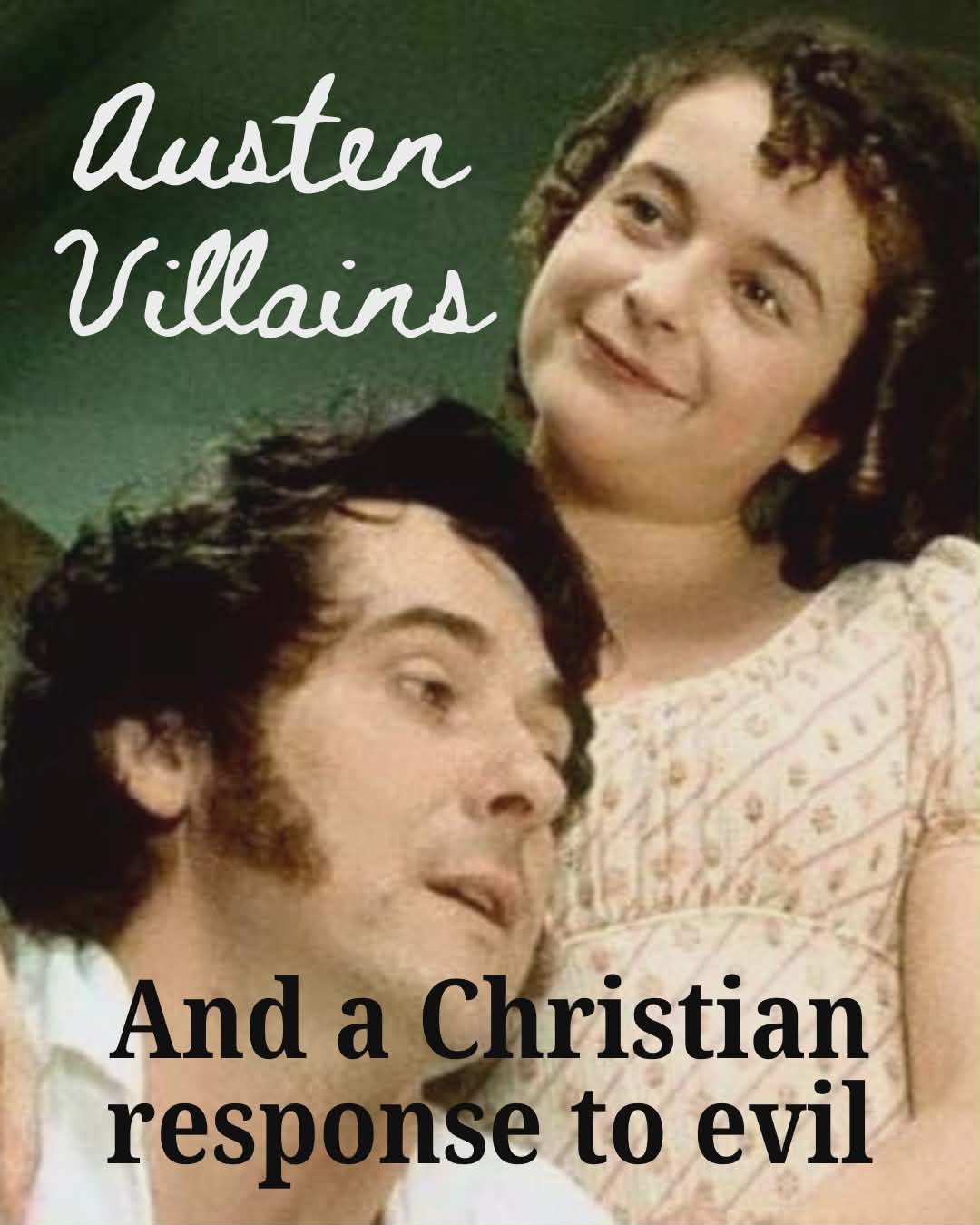
My mind couldn’t help but go to the villainous Mr. Wickham of Jane Austen’s Pride and Prejudice. Although the trail of disaster that he left behind isn’t a direct comparison to what is going on in the world today, there are some similarities. It was, however, the response of those who discovered his true character that had me contemplating.

If you know the story, you’ll remember that Mr. Wickham, a ward of Mr. Darcy’s father, squanders the inheritance that was left to him. When Mr. Darcy refuses to give him more money, Wickham attempts to steal some of the Darcy fortune and get revenge by eloping with Mr. Darcy’s 15-year-old sister, Georgiana. In this instance, his plans were foiled.

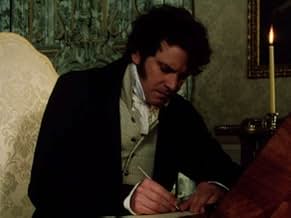
We first learn of these events, and of Wickham’s true character, in a letter that Mr. Darcy writes to Elizabeth. Mr. Darcy tells her about Wickam’s misdeeds in order to defend his own character after Elizabeth turns down his marriage proposal—partly because she believed Wickam’s lies, which painted Mr. Darcy as the villain. I guess the moral here is to get our facts straight before we jump to conclusions about a person’s character. There are a lot of accusations going around the Internet today. We need to make sure we know the truth before we share anything.

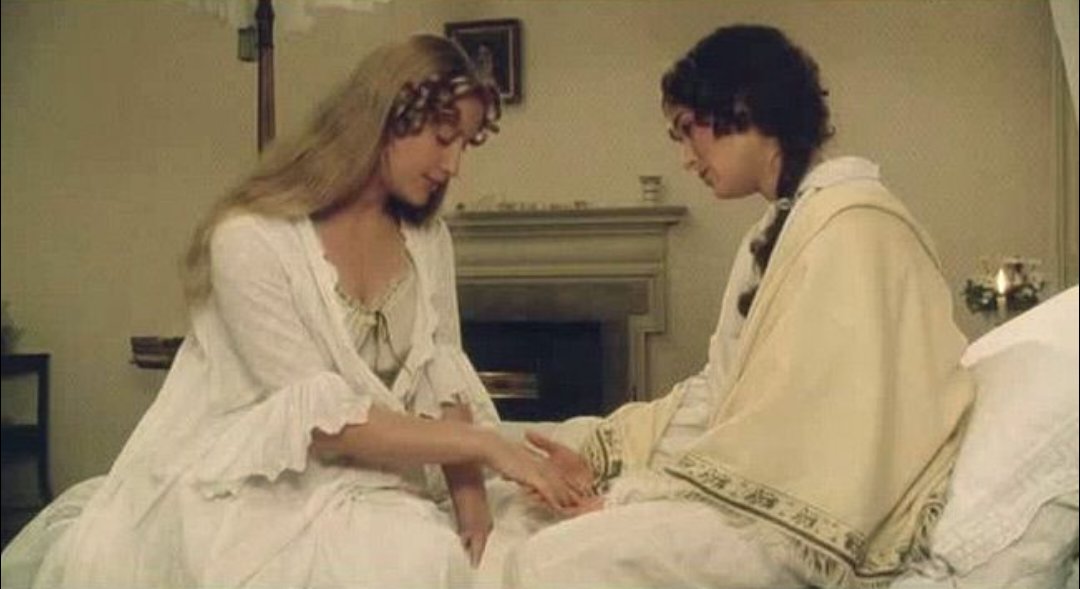
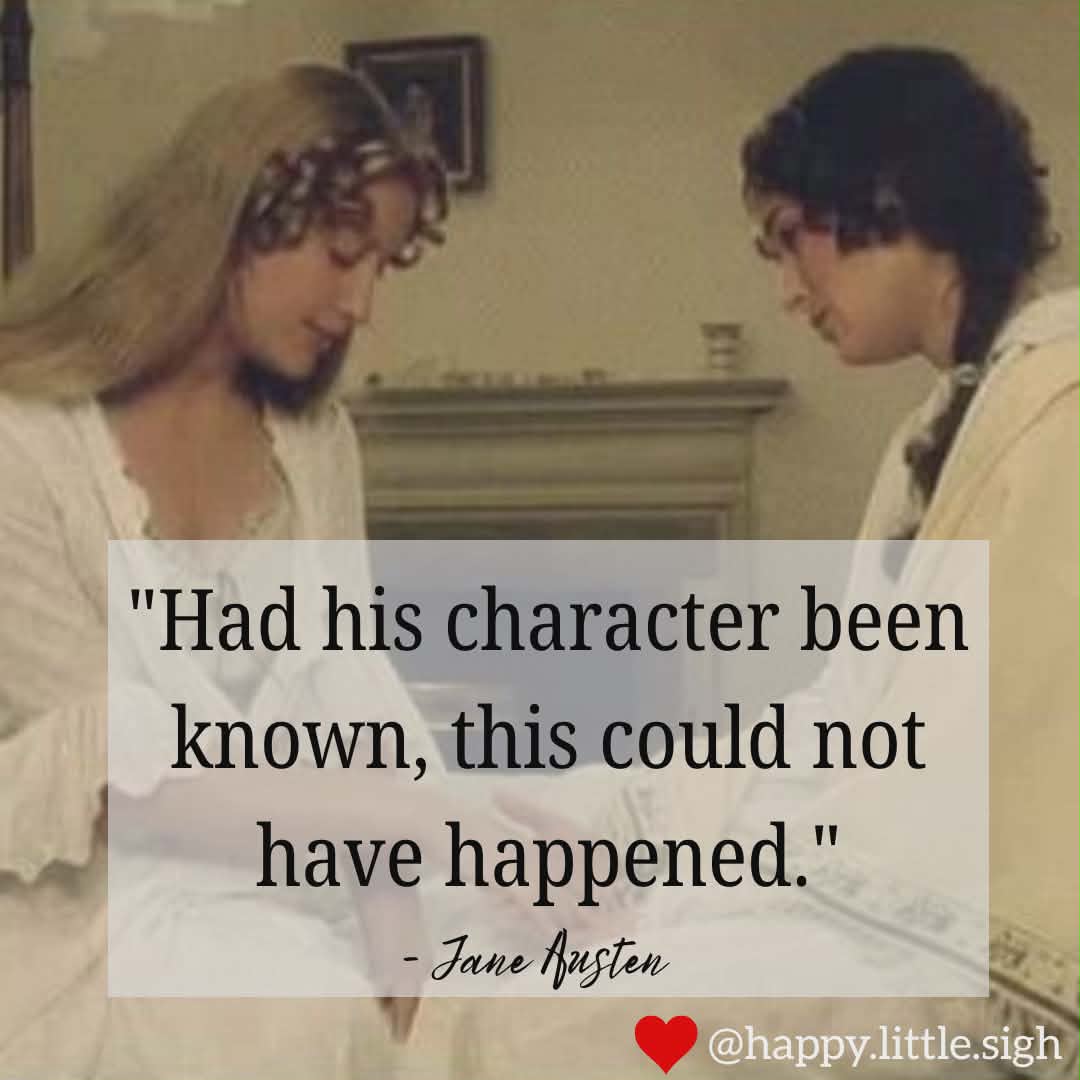
When she returns home, Elizabeth shares the shocking story with her trusted sister, Jane. When we’re unsure if we should speak out, it’s wise to choose one trusted person and ask their help to decide. We should note, however, that while the girls discuss Wickam’s squandering of the money and attempted elopement with Georgiana, they do not linger on the sordid details or try to find out more. They knew it happened, and that is enough. Unless there is a specific reason that we need to find out more, I think that should be our response, too.

“I want you to be wise about what is good and innocent about what is evil.” – Romans 16:19 ESV

The girls also discuss whether or not they should tell their family and friends about Wickham’s past. They are concerned about gossiping, harming innocent parties, and betraying a confidence.  Jane says, “Surely there can be no occasion for exposing [Mr. Wickham] so dreadfully.”

Elizabeth seems less concerned for Wickham’s feelings, but says, “every particular relative to his sister, was mean to be kept as much as possible to myself.” Along with not wishing to betray Mr. Darcy’s confidence, she doesn’t wish to drag Georgiana’s name through the mud along with Mr. Wickham’s. She also believes that as Mr. Wickham is so popular, no one would believe anything bad that she says about him. Unfortunately, the girls’ decision not to tell anyone about Wickham’s true character nearly cost their own youngest sister—and themselves—a happy future. 

Soon after, Wickham successfully disappears in the night with Lydia, Elizabeth and Jane’s 15-year-old sister. What was so wrong with eloping? Technically, Wickham did not break the law. In England at that time, the age for consent to marry was a mere 12 years old. However, we should consider God’s law as well as man’s. Such a match was looked down upon when it lacked parental blessing. Not only that, but as we know, it was not even marriage that Wickham had in mind. Though we later learn that Lydia believed they were actually going to elope, they were discovered living together in London—unmarried. Thanks to the help of Mr. Darcy and the Bennet’s uncle, Lydia was “saved” from the life of an outcast when Mr. Wickham was all but forced to marry her (though how good this was for her, I am not so sure). If they had not married, then not only Lydia’s, but the reputation of all the Bennet girls would have been ruined. They would have been basically unmarriageable—especially to anyone of good standing in the community. So apart from the immorality of the situation, Wickham’s actions showed dishonor toward Lydia’s entire family.

And it’s not only Wickham’s attempts to run away with these young girls that speak against him. “All Meryton seemed striving to black the man . . . He was declared to be in debt to every tradesman in the place, and his intrigues, all honored with the title of seduction, had been extended to every tradesman’s family.” It seems many in the community had formed a bad opinion about Wickam, but none of it came out until Lydia’s disappearance.

I found myself thinking how much could have been prevented if someone—Mr. Darcy, Elizabeth and Jane, or even one of the tradesmen from Meryton—had spoken up and shared what they knew of Wickham’s character sooner. Perhaps Lydia would have begun to think badly of Wickham. Perhaps Elizabeth would not have turned down Mr. Darcy with such vehemence. Perhaps further tradesmen would have not lost so much money. Perhaps other young ladies in the village wouldn’t have been toyed with as they were.

But exactly what details about Wickham should have been shared, and to whom? In the Bennet’s case, no one (except perhaps Kitty) knew of Lydia’s preference for Wickham. In real life, as well as in fiction, it can be hard to decide when to share information. We do see that both Elizabeth and Darcy realize that their silence directly permitted Mr. Wickham to continue harming more people. Elizabeth laments, “When I consider that I might have prevented it! I, who knew what he was.” Mr. Darcy says, “I was wrong. I ought to have my situation known at the time.”

It’s true, when we see someone do something that is dishonest, unjust, harmful, or dangerous, we do need to consider whether or not it is our responsibility to share the information and to whom we should share it. Too often sin is covered up, allowing the person to continue in their harmful ways. Then there are times when we simply don’t need to say anything, and to do so would be mere gossip.

What we need to remember foremost is that God is a God of truth and justice, and that it is our responsibility to follow God’s example in this way. Christians should lead the way in promoting truth and justice!

“Take no part in the unfruitful works of darkness, but instead expose them.” – Ephesians 5:11 ESV

God also calls us to defend the weak and the needy.

“Learn to do good; seek justice, correct oppression; bring justice to the fatherless, plead the widow’s cause.” –Isaiah 1:17 ESV

“Speak up for those who cannot speak for themselves, for the rights of all who are destitute. Speak up and judge fairly; defend the rights of the poor and needy.” – Proverbs 31:8-9 ESV

If you find yourself in the situation of knowing about wrongdoing and aren’t sure what action to take, DO follow Elizabeth’s example by consulting a wise and trusted friend without discussing or prying for unnecessary, sordid details that will only degrade your own mind. And DO ask yourself the following questions about the information you have about a person–

  • Is it a crime?
  • Could someone be harmed if I stay silent?
  • Is this person in position of authority, where trust is essential?
  • Am I telling the right people (police, pastor, parent, etc.)?
  • Do I need to confront the person directly? (Galatians 6:1)
  • Do I have my facts right? (Exodus 23:1)
  • Am I sharing the information only with people that need to know?
  • Am I the right person to share this information? Is it my news to tell?
  • Is my motivation to help someone or to attack someone’s character?
  • How can I share this information safely?

If we have the ability to stop evil and prevent harm, then it is our responsibility to do so, in the right way and to the right person. In the case of Mr. Wickham, he got off far better than he deserved. Thankfully, our “dearest, loveliest Elizabeth” and “dear Jane” got their happy ending, despite everything. I hope in the case of the horrendous goings on in our news today, that evil is exposed, justice is served, and that the hurting find true healing.

Learn to love mornings & grow in faith . . .

Bookish devotionals for busy moms. Sign up here FREE

Connect with me on Instagram/Facebook @happy.little.sigh

Read Full Post »

You never forget such a dream–a dream where Jesus lifts you, puts you in His pocket. So warm. Safe. Loved. Light shining through white softness, close there to His heart. It was that dream that I thought of over the weekend, when after one adoption delay and hurdle after another, our entire dossier went missing in the mail. Though in my grief I had been tempted to run, instead, my fingers clenched to the clean, white softness of His robe. I let my tears fall and soak up there, knowing He would count every one. And there at His feet I lay, knowing there was nowhere else to go—nowhere else I would want to go—determined to stay there, until I got some answer.

And I have to tell you, that no matter what is happening in your life, there is no better place to be. What sweet sorrow, feeling our hurt, our confusion, the longing of our bones . . . Yet knowing He knows it all, and sympathizes with us in our weakness, and that even though we cannot see it, He is working it all for our good. Even if the end result is the opposite of what we have prayed for, it is for His glory and for our eternal good.

Imperfectly, I wrestled, pleaded, waited . . . Thursday, Friday, Saturday, Sunday, Monday . . . I had waited over forty years for a baby daughter. What was another few months to make up the paperwork we had lost? To me, it felt like a very lot. I couldn’t bear to look at the children’s photos. and though the temptation had been to let my heart grow cold toward Him–when all my prayers for speed, and blessing, and favor seemed for naught–I determined to press in, press closer, wait there.

“Let us hold firmly to what we profess. 

For we do not have a high priest who is unable 

to sympathize with our weaknesses,

 but we have one who was tempted in every way that we are, 

yet was without sin. 

Let us then approach the throne of grace with confidence,

so that we may receive mercy and find grace

to help us in our time of need .”

~Hebrews 4:14-16 BSB

Things were sent to me to help me. A book—The Practice of the Presence of God, by Brother Lawrence. I listened to it all. A hymn—”I’d rather have Jesus.” I listened to that, too. I listened, and I re-listened, and I sang aloud. And I felt then, His nearness. His love. The awesomeness of His power. The closeness of eternity.

And Monday came, and I went about the busyness of my day, carrying on with organizing our home in preparation for the children’s arrival. Homeschooling my boys, believing there would yet be an adoption to carry us overseas during the coming school year. In the afternoon, I went to the grocery store for a few items for dinner. Sitting there in the steaming heat of my car, I checked my phone and found an email from the agency—the dossier had been located!

I tried to comprehend how. The Post Office claimed the dossier had been left outside the agency, which is situated in an inner-city area, the previous Wednesday. The agency had searched for, and been unable to find it. Five days had passed. Suddenly, the dossier was discovered outside, right where the post office said it should be. A miracle.

I sat in my car and cried, tears pouring down—this time because that which was lost had been found. And because God had shown His goodness and His mercy and His power.

And so now our adoption is up and running again—we might even get to see the kids this autumn! But I can tell you, with all honesty, that I am glad those papers went missing. I am glad for the pain I was allowed to feel. Without that despair, I would not have turned so desperately, so passionately to my Creator. I would not have experience the sweetness of being so wholly in His presence, or resting there at His feet. I pray I may always feel as close to Him as I do today. That I may always trust Him, even when things aren’t going my way. Because He is trustworthy. He is gracious. He is good. He is wise. He is love. And why, oh, why, would I run away from that?

“The difficulties of life do not have to be unbearable.

It is the way we look at them – through faith or unbelief – that makes them seem so. We must be convinced that our Father is full of love for us and that He only permits trials to come our way for our own good.

Let us occupy ourselves entirely in knowing God. The more we know Him, the more we will desire to know Him. As love increases with knowledge, the more we know God, the more we will truly love Him. We will learn to love Him equally

in times of distress or in times of great joy.”

― Brother Lawrence, The Practice of the Presence of God

Learn to love mornings & grow in faith . . .

Bookish devotionals for busy moms. Sign up here FREE

Connect with me on Instagram/Facebook @happy.little.sigh

Read Full Post »

I have stories yet untold. I suppose I wasn’t sure if they were mine to tell. But some stories deserve to be told, and some people deserve to have their story told, though they cannot tell it themselves . . .

In the far north of Scotland is a castle. A small, elegant, brownish-pink castle–a stone’s throw from the sea, yet bordered by attractive gardens, with sheep-grazed pastures and woodlands beyond. It is called the Castle of Mey, and belonged to the late Queen Mother. Not the Queen who passed away one year agone, but her mother, HM Elizabeth The Queen Mother. She purchased the ramshackle castle in 1952, and set about restoring both castle and grounds. It became her summer home (with another visit every October). Here, she enjoyed the natural beauties of Scotland, and here she entertained guests. I couldn’t tell you much about those guests–apart from one. About one couple’s visits to The Castle of Mey, I know quite a lot. I know, because they told me themselves.

The minister of The Church of Scotland Parish of Canisbay and Keiss, the region of Scotland called Caithness where the castle is situated, was for a time one Reverend Alex Muir, MA BD. To you, just a name, to me a thousand memories–most of which occurred at a modest house in the small Scottish city of Inverness. Again, just a house, just number 14, to me so much more. Alex (retired from the ministry by this time) and his wife, Catriona, were members of our church. They were acquaintances who became, in a matter of no time at all, close friends. Me, a young American, still smitten with Scotland, still lonely from time-to-time, still prone to say the outlandish things that Americans tend to say while on foreign soil. John, a Scot, but not known in the “highlands and islands,” and with much to occupy him in his new position at work. We two just a young couple, trying to find our way in the world.

An afternoon at “number 14” – Alex & Catriona are far right

We were invited for lunch one Sunday–a Sunday that became the first of many–and what a delight to be in the home of new friends. I remember the sunny dining room with a view of Catriona’s colorful garden. I remember the blue, yellow, and green budgies, chirping and flitting about their large cage. I remember the black and white photo of Alex and The Queen Mother, hung on the wall. The story behind that photo came to me in stages over the next few years, on visits to number 14. Oh, I loved to be there, amid the old books, and photographs, and cassette tapes–all the ideas, and stories, and melodies, wrapped up inside. Oh, I loved the smell of Catriona’s fluffy scones just out of the oven. Oh, I loved to chat with their boys (all round about my and John’s age) and to hear the stories Alex would tell. Oh, I loved the love in that place.

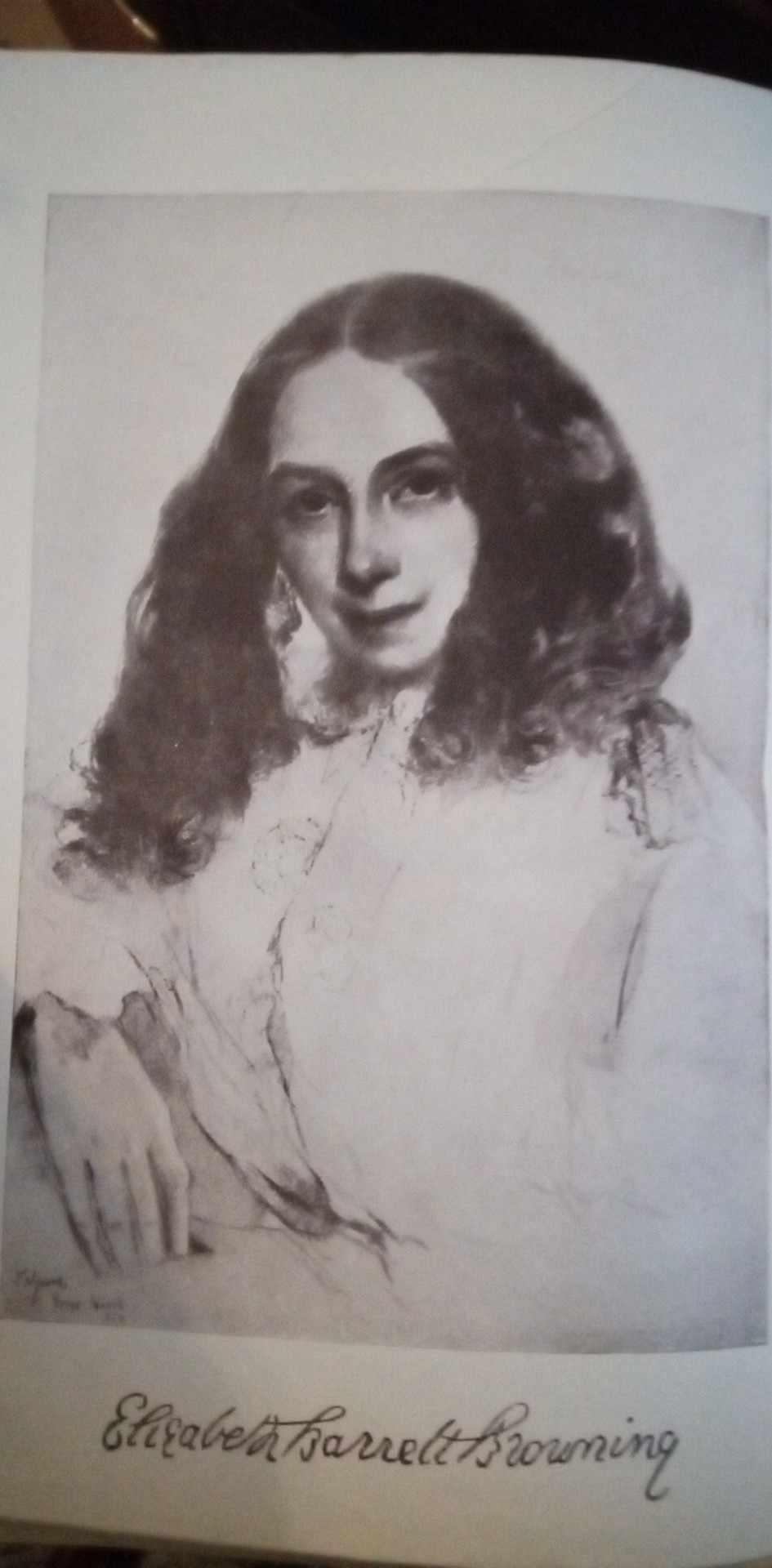
Alex, a teacher before his years as minister, was a true Encyclopedia of Scottish history and literature. I remember lending him my CD of Lorena McKennit’s musical rendition of The Lady of Shallot. I rather think that could Alex have been transported to The Eagle and Child Pub in Oxford during the 1940s, he would have joined in with the discussions of C.S. Lewis, J.R.R. Tolkien, and the other Inklings without any effort at all. One day, he presented to me his copy of Mrs. Browning’s Poetical Works, saying that the poet’s hair rather reminded him of mine. But I digress . . .

Literature was not, however, the foremost thing on Alex’s mind. The Scottish Christian revivals of the 19th century–which had transformed so many lives and communities–and church music were the things he spoke about with the most passion. He was a great admirer of American hymnwriter Ira Sankey, composer of Just as I Am, Have Thine Own Way Lord, I Surrender all, and many others. Alex was also an amateur composer and lyricist himself–one who had attracted the notice of The Queen Mother, and in time, The Queen herself . . .

During his years as minister in Caithness, Alex and Catriona (as the parish minister and his wife) were invited to dine at The Castle of Mey on multiple occasions. They came to know and hold great respect for The Queen Mother, and Alex felt quite convinced of her sincere faith in the Lord. One time, she requested a tour of their home, the Manse. Catriona dutifully and I am sure graciously consented. She later told me that when The Queen Mother glimpsed her oldest son’s room, plastered with posters of footballers and movie stars, that she remarked, “All these precious things.” Catriona declared that The Queen Mother always knew just what to say.

The photo from the dining room wall – Alex accompanying The Queen Mother outside Canisbay Kirk

On learning that Alex was musical, The Queen Mother asked him to bring along his guitar on his visits to the castle. He played Scottish ballads, folk music, and his own compositions. There’s a story about her making a request for “The Jeely Piece Song.” It would have been at the castle that The Queen, on one of her visits to her mother, would have first met Alex and Catriona and heard him play. It’s all rather like a Scottish fairytale, castle and all, but the story doesn’t end there . . . The Queen apparently so loved Alex’s beautiful, haunting melody, “Bays of Harris,” that she selected it to be played at her funeral, should she pass from this life while in Scotland–which she did. My heart swelled as I watched the talented Karen Matheson sing the words of Psalm 118 in Gaelic to Alex’s melody. How I wished Alex had been there to see his melody performed for The Queen one last time! Bays of Harris was also used at the funeral of former parliament member Winnie Ewing, in Inverness Cathedral. It was sung there by another famous Gaelic singer, Julie Fowlis.

Alex went to his own Heavenly Castle in 2010, and Catriona followed ten years later. I think of them often. A piece of my heart went to Heaven when they left. But oh, so glorious to know their lives–and Alex’s music–are yet reaching hearts and inspiring lives. I wondered what had inspired The Queen to choose Psalm 118. She was very particular in all she said and did. Every Christmas, The Queen gave a Christmas speech, and without fail, every year she spoke about the Savior. Wise and thoughtful woman that she was, she would have known that her funeral was her last chance to “give a speech,” her last chance to address the world. Years before she passed, she carefully chose every word–from hymns to Bible texts–that would be part of her final day. Could it have been verses eight and nine that she wanted to impress upon the hearts of all who were listening that day?

It is better to take refuge in the LORD

than to trust in man.

It is better to take refuge in the LORD

than to trust in princes

-Psalm 118:8-9

It’s been twenty years now since The Queen Mother passed, a year since The Queen herself–I have confidence that she, Alex, and Catriona are now reunited in their glorious bodies–but their legacies live on. And so will the legacies of Alex & Catriona, for all who knew them, and for all who are touched by Alex’s music–today, and for generations to come.

Bays of Harris, Psalm 118, sung by Karen Matheson, former singer with the group Capercaillie, at St Giles Cathedral in Edinburgh for the Queen’s funeral (sadly, credit was given to the man who arranged the melody instead of to the composer, Alex)

Psalm 63 sung by Clare Ross to Bays of Harris. Clare recorded this piece with Alex in the 1980s. You will hear English at the end.

God Has Given Us a Dream – Hymn and melody by The Reverend Alex Muir, MA BD, sung by singer and filmmaker, Matthew Todd of Fellowship Film


Avonlea xo

Learn to love mornings & grow in faith . . .

Bookish devotionals for busy moms. Sign up here FREE

Connect with me on Instagram/Facebook @happy.little.sigh

Happy Little Sigh

Homemaking Inspiration from Literature  ♥

PS Enjoy the story behind the writing of Bays of Harris, including an interview with Alex, below ⤵

Read Full Post »

For you created my inmost being;

    you knit me together in my mother’s womb.

I praise you because I am fearfully and wonderfully made;

    your works are wonderful,

I know that full well.

-Psalm 139:13-14

After nine long years, I find myself here once again. This place that was so dear to me as home. So inspiring to all my senses, and aspirations, and heart. I hardly want to sleep (though I am). Hardly want to miss a second of all this sweet Scottish air (oh, how purple the heather on the hills just now!). Don’t want to miss a minute with the sweetest of friends who will be, through eternity, lodged in my heart.

Our first weekend we went to Inverness to stay with friends from our former church. First a play at the park with my sweetest friend Mhairi and her boys–oh, what fun to have Scottish children to show them all the best climbing trees and hiding spots! Then at Maureen and Alasdair’s, where there’s endless snacks for the children to keep up their strength, and endless cups of tea, and her beautiful garden where the boys picked raspberries, and her husband’s workshop where he helped them make wooden porridge stirrers, and all the talk of things big and small that we managed to cram in-between. I tried to soak, soak, soak up all the love and goodness and wisdom I have always felt from their presence.

And at Rona’s, the stunning views over the highlands toward Loch Ness, and the mouth-watering Indian food she prepared, and the kids laughing with her son over a game, and realizing how similar a path we tread from different corners of the earth, and the talk of grace that seasoned it all.

Seeing these precious faces again, I thought maybe my heart would burst. Burst because of the loving so very much, or burst because of the having to say goodbye. It seems unthinkable that it’s been nine long years since I last saw them or last breathed the sweet highland air. Unthinkable that in three weeks I will once again have to say goodbye. That their life will go on, and so will mine, and who knows when we’ll meet again. The only thing that keeps it all from being too much is thoughts of eternity . . . One day, one day, we will all be together. And all those lattes, and cups of tea, and cakes, and misty mountains, and faces of friends, well, they will just not stop. Death will be dead and so will goodbyes.

Why would I want anything else? Why would I want to be anyone else but what God has made me? Why I would I want any other end than the one He has prepared for me? The thought that God not only created us with foresight, purpose, and detail but also continues with us throughout our lives with the same love, wisdom, and attention to detail is utterly mind-numbing. He made those friends. He made me. He brought us into each other’s lives, and He will carry each of us through until we are all reunited in the end. “But thanks be to God! He gives us the victory through our Lord Jesus Christ.” (I Corinthians 15:57).

“Dear Lord, thank you for the sweet friends in Christ you have blessed my life with. Thank you for making each of us with care. And thank you that you will carry each of us till the end–till we are forever with each other and you. Amen.”

Avonlea xo

Learn to love mornings & grow in faith . . .

Bookish devotionals for busy moms. Sign up here FREE

Happy Little Sigh

Homemaking Inspiration from Literature ❤

Read Full Post »

For those of you who don’t follow me on social media, you may not have heard that The House on Cherry Street now has audio and ebook (Kindle and other) versions available. The audiobook is narrated by the beautiful Scottish voice of voice actress, Angela Ness. Perfect for road trips and work or school commutes!

Book description –

Forbidden Love in a time of war. The house that kept the secret for generations… until someone comes looking for the truth.

Michigan, 1941 – Grace, daughter of a wealthy furniture baron, can have anything she wants—except her one true love.

Scotland, 2014 – Charlotte has big plans for her summer–when a surprise letter from America changes everything . . .

Grace – Grace’s life is dictated by society and her father’s wishes, right down to the man she’ll marry. So when she falls for Georg, she must keep their love secret–all while keeping up the pretense of going steady with another man. As America is forced into WWII, Grace must fight for all she holds dear. Who is following her and Georg? Grace’s intended, or someone with more sinister plans? Grace thinks she knows who’s to blame, but as events unfold, she realizes all was not as it seemed . . .

Charlotte – When an out-of-the-blue plane ticket to America arrives, Charlotte decides to use it, even if this means putting wedding planning and the purchase of her dream bed and breakfast on hold. But her trip becomes a solitary stay in a crumbling mansion and a puzzle at every turn. Thankfully, her life back in Scotland is falling nicely into place—or is it? Meanwhile, missing documents leave her confounded. Will the house give up its secrets at last?

🍒 Shop here

A LITTLE NEWS!

In less than a month, we leave for Scotland for a month-long visit! Stay connected on FB/IG/MeWe for photos, videos, and the whole scoop! My Instagram was lost, sadly. If you’re an Instagrammer, reconnect with me on happy.little.sigh here

Happy Little Sigh

Homemaking inspiration from Literature ❤

Read Full Post »

🍒 It’s finally here! My book, The House on Cherry Street, is now available on Amazon – Link

From Edinburgh, Scotland to Grand Rapids, Michigan, this story brings to life Michigan’s once vibrant furniture industry and the history of the US internment of German Americans. Read the description below . . .

Forbidden Love in a time of war. The house that kept the secret for generations… until someone comes looking for the truth.

Michigan, 1941 – Grace, daughter of a wealthy furniture baron, can have anything she wants—except her one true love.

Scotland, 2014 – Charlotte has big plans for her summer–when a surprise letter from America changes everything . . .

Grace – Grace’s life is dictated by society and her father’s wishes, right down to the man she’ll marry. So when she falls for Georg, she must keep their love secret–all while keeping up the pretense of going steady with another man. As America is forced into WWII, Grace must fight for all she holds dear. Who is following her and Georg? Grace’s intended, or someone with more sinister plans? Grace thinks she knows who’s to blame, but as events unfold, she realizes all was not as it seemed . . .

Charlotte – When an out-of-the-blue plane ticket to America arrives, Charlotte decides to use it, even if this means putting wedding planning and the purchase of her dream bed and breakfast on hold. But her trip becomes a solitary stay in a crumbling mansion and a puzzle at every turn. Thankfully, her life back in Scotland is falling nicely into place—or is it? Meanwhile, missing documents leave her confounded. Will the house give up its secrets at last?

🍒 What happened before chapter one? I’m offering two FREE bonus prologue chapters to anyone who leaves me a review. Simply email me a screenshot of your review to happylittlesigh@gmail.com and they will be yours!

Avonlea x

Learn to love mornings and grow in faith…

Bookish Devotionals for Busy Moms

Sign up HERE

Happy Little Sigh
Homemaking Inspiration from Literature ❤
Read Full Post »

Everywhere, there were walls. Day by day, they’d grown up around us till every house and shop and school and road had its own borders, its own barriers. Keeping things out, keeping them in. Walls, running all over this frozen land. Walls made of snow. Not that the barriers were intentional, when we all went out with our shovels, blowers, and plows. But the walls came anyway, as we made a path from door to car, from car to sidewalk, from sidewalk to road. But at our house, we also had a path. A path between our neighbours’ house and our own.

Not that we’d used it often, that imaginary gateway, that break in the wall. No, not in such a winter when the snowfall set records and people had to shovel their roofs so they wouldn’t collapse under the weight, and icicles hung like thick stalactites from gutters, and the painful wind and cold brought tears to your eyes and chapped hands and cheeks and lips. No, not in such a winter.

CAM001351

CAM001411

CAM001341

But then there came a day, one soft and snowy Sunday, when we did. Church had been canceled after an ice storm left thousands without power. So we were home, the day before us a little lonely and uncertain and unfilled. But then there came a knock.

I shuffled to the mud room in my slippers, found the tall frame of our neighbour filling the glass door. Expecting him to ask John’s help with the snow or maybe something to do with frozen pipes, I reached for the handle, hoping all was well.

“We’re not going anywhere today, and neither are you,” he said. “We’ve got a ham in the oven and we’re hoping you’ll come over and help us eat it.”

Well, such an invitation! Such a welcome invitation on such a silent, snowy day.

And so we put on our boots, didn’t bother with coats, and filled the silence with our chatter as we walked that path, that break in the wall of snow, and into our neighbours’ large kitchen.

CAM00367

CAM00362

CAM00368

CAM00492

We stayed for hours. And I couldn’t tell you what it meant to sit round their table, surrounded by photos of their grandchildren and a collection of Eiffel Towers. But it was more than the ham and potatoes and veg that we ate while we talked and laughed. More than the tea and cookies and jello that came next. More than the stories from days past, told with such animation that we laughed over till our sides hurt. More than our neighbours themselves, who had begun as kind strangers and turned into friends.

It was the sum of it all that filled us that day, warmed us from the inside out, made us feel that winter was the most wonderful of seasons because it had brought us together–could bring us close to other family and friends–before spring came and the world opened up and let us sprawl out, warm in the sun but far from each other.

March is nearly upon us, but the temperatures are still frigid, and until the warmth comes to melt the mountains of snow and banish the walls, we will have winter. And for as long as it lasts, for all those long Saturday afternoons and black winter nights, I’ll be searching for ways to warm our home, to warm the hearts of our friends. With big pots of chili, and spontaneous tea parties with plates of shortbread taken from the rations John’s parents bring.

And that is the best way to not just survive winter, but love it.

It is said that good fences make good neighbours, and I agree. Good fences, good walls, they make good neighbours–but only when there is a gate.

CAM00533

~~~~~~~~~~~~~~~~~~~~~~~~~~~~~~

And there is quite a different sort of conversation around a fire than there is in the shadow of a beech tree…. [F]our dry logs have in them all the circumstance necessary to a conversation of four or five hours, with chestnuts on the plate and a jug of wine between the legs. Yes, let us love winter, for it is the spring of genius.

~Pietro Aretino, translated from Italian

~~~~~~~~~~~~~~~~~~~~~~~~~~~~~~~~~~

Nature looks dead in winter because her life is gathered into her heart. She withers the plant down to the root that she may grow it up again fairer and stronger. She calls her family together within her inmost home to prepare them for being scattered abroad upon the face of the earth.

~Hugh Macmillan, “Rejuvenescence,” The Ministry of Nature, 1871

~~~~~~~~~~~~~~~~~~~~~~~~~~~~~~~~~~

CAM004321

CAM00391

Avonlea xo

Find me on . . .

Instagram/Facebook/MeWe @happylittlesigh

Happy Little Sigh

Homemaking Inspiration from Literature ❤
 ❤ For HOMEMAKING INSPIRATION FROM LITERATURE  & a PERIOD DRAMA in your inbox EVERY Friday sign up here! ❤

Read Full Post »

CAM00393

I know all about lists.

I know all about lists of things that should have been done yesterday . . .

last week . . .

last year . . .

I know all about adding something to your list

just so you can cross it off

and feel like you’ve done

something.

And I know all about those things that stop you,

get in your way.

The things that need to be done everyday and keep you from getting ahead.

All that time in the kitchen that can leave you wishing

that you didn’t need to eat.

Those mountains of washing (clean or dirty)

that never, ever go away.

And I know what it’s like to trip over a toy, drag it back to where it belongs

for the seventh time that day.

Or what it’s like to feel frustrated by a spilled drink

(oh, do I!).

What it’s like to feel a little less than sympathetic

when someone gets an owie,

bursts into hysteric tears,

yet again.

Oh, and isn’t it easy to grow frustrated, feel hopeless

at the impossibly long list of jobs you want to get done–

those emails, those phone calls, those jumbled closets and drawers.

And it’s easy, far too easy,

to forget

the very reason

that you even do it all.

And forget the very people behind the reason

you’re making those phone calls, cooking those meals, cleaning that house.

You can forget

that for those of us home raising little souls,

our children are not a distraction from our work,

they are the purpose of it.

PC0200202

And so next time you feel disheartened

by all the things you didn’t do,

remember what will matter

a week, a year, or more from now.

Remember what they will remember

when they go.

And take the time to pull them close,

tell them how they’re loved

by God,

by you.

And pull them close to read

that favourite, dog-eared book.

And kneel down to tell them,

as if there’s nothing else,

what they’ve done right,

or how what they’ve done has hurt another

and how they can make it right.

For raising souls should not be rushed, 

is not a side-line job. 

And while we long to make a beautiful, harmonious haven

for those we love,

it is not the meals we cook, the dust we extinguish, the pictures we hang,

but the love we give, the patience we show,

the fruit of the Spirit within us, 

the Spirit we help them to grow inside

that they will remember most,

that will really matter

in the end.

Avonlea x

Start your MORNINGS with Jesus & Your favorite books!

For FREE literature-inspired devotionals SIGN UP here!

OR find me on . . .

Instagram/Facebook/MeWe @happylittlesigh

Happy Little Sigh

Homemaking Inspiration from Literature ❤



Read Full Post »

Older Posts »